Curated News
By: NewsRamp Editorial Staff
September 18, 2026
Western Star Hits 0.53% WO3 in Soil at Rowland Tungsten, Nevada

TLDR
- Western Star's Rowland soil survey found 0.53% WO3, extending tungsten zones beyond historical workings for a first-mover drilling advantage.
- Western Star collected 315 soil samples at Rowland, using lithium borate fusion to define two tungsten anomalies for drill targeting.
- Western Star's tungsten exploration in Nevada supports domestic critical mineral supply, potentially enabling cleaner technologies and economic benefits.
- Western Star's best soil sample returned 0.53% WO3, 250 metres from any known working, showing untested ground can yield surprises.
Impact - Why it Matters
This news matters because it underscores the potential for discovering new tungsten resources in a historically productive mining district. Tungsten is a critical mineral essential for defense, manufacturing, and technology applications, and the United States currently relies heavily on imports. The identification of high-grade soil anomalies, particularly on untested ground, suggests the possibility of a significant new discovery that could enhance domestic supply security. For investors, the results validate Western Star's systematic exploration approach and set the stage for drill testing, which could lead to a major catalyst. As the global demand for critical minerals rises, successful exploration at Rowland could position Western Star as a key player in the domestic tungsten space.
Summary
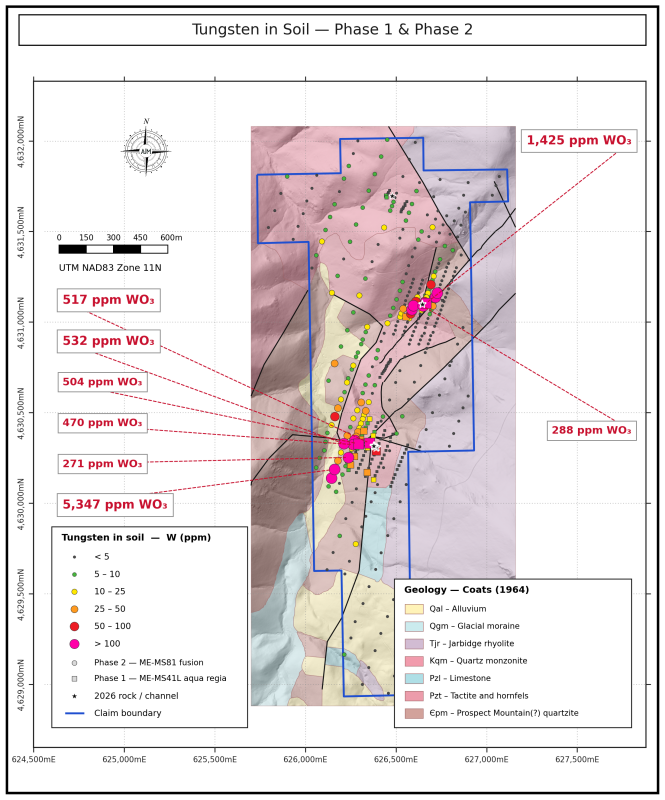
Western Star Resources Inc. (CSE: WSR) (OTC: WSRIF) (FRA: 4K2) has announced promising results from its Phase 2 soil geochemical survey at the Rowland Tungsten Property in Elko County, Nevada. The survey, consisting of 315 soil samples, defined two discrete tungsten-in-soil anomalies: the Rowland Main anomaly and the Northern Zone B anomaly. The Rowland Main anomaly spans approximately 190 by 630 metres with 18 anomalous samples, including a peak value of 4,240 ppm W (0.53% WO3) at sample R079, which also returned the highest tin value in the survey at 66.9 ppm Sn. Notably, this best sample lies 250 metres from the nearest historical working on ground with no recorded past activity. The Northern Zone B anomaly covers 190 by 190 metres with 13 anomalous samples, peaking at 228 ppm W, and is located close to rock-chip samples that previously returned 0.35% to 1.22% WO3.
CEO and President Blake Morgan commented, “These results show the methodical exploration approach is paying off. We have defined two significant soil anomalies over the historical workings and extended the recognised footprint well beyond them. Northern Zone B is the tighter of the two, a compact cluster elongate to the northeast, sitting within the modelled intrusive. Rowland Main is the larger footprint, and its best sample, 0.53% WO3, lies 250 metres from the nearest historical working on ground with no recorded past activity. That is the part that interests us most: the strongest result came from ground nobody has tested.” The anomalies are supported by geophysical data, with Northern Zone B lying within a modelled intrusive body and Rowland Main associated with an interpreted magnetic-high lineament. The company plans to integrate these soil results with UAV magnetic survey data, three-dimensional magnetic inversion, and rock-chip assays to advance drill target generation. Soil geochemistry from the nearby White Star Tungsten Project remains pending. For detailed visuals, Click Here Figure 1 and Click Here to see Figure 2, and for assay data, Click here to see Table 1. The original release is available on www.newmediawire.com.
Source Statement
This curated news summary relied on content distributed by NewMediaWire. Read the original source here, Western Star Hits 0.53% WO3 in Soil at Rowland Tungsten, Nevada