By: Press Services
December 3, 2025
Data Study Shows That AI Search Engines Reference Different Sources Than Google
Study Breaks Down Differences in Results Between AI Search Engines Like ChatGPT and Google
New York City, United States - December 2, 2025 / Search Atlas /
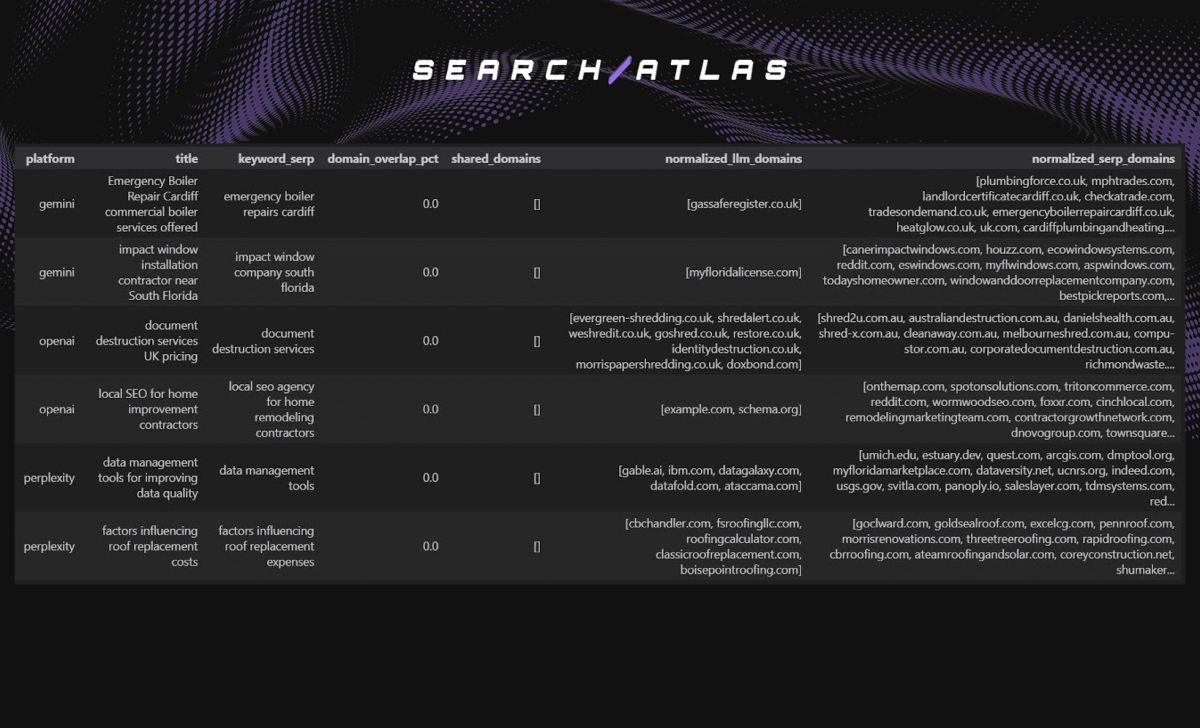
Analysis of 18,377 query pairs shows retrieval-based AI systems like Perplexity achieve 43% domain overlap with Google, while reasoning models like ChatGPT cite only 21% of the same sources
Search Atlas, the leading AI-powered search marketing platform serving over 6,000 brands, today released research analyzing how large language models (LLMs) like ChatGPT, Perplexity, and Google Gemini differ from traditional Google Search results. The comprehensive study of 18,377 semantically matched query pairs reveals that AI-generated answers cite fundamentally different web sources than those appearing in search engine results pages (SERPs), creating urgent implications for brand visibility in the emerging Generative Engine Optimization (GEO) landscape.
The research, conducted by Search Atlas Founder and CEO Manick Bhan and the company's research team, provides the first large-scale empirical analysis of LLM-SERP alignment, measuring exact overlap between AI-cited sources and Google-ranked domains across informational, navigational, transactional, evaluation, and understanding query types.
"We're witnessing the emergence of a parallel information ecosystem," said Manick Bhan, Founder and CEO of Search Atlas. "While traditional SEO focused exclusively on Google rankings, our research proves that AI search engines and large language models reference different sources, rank different domains, and prioritize different content attributes. Brands that ignore this shift risk becoming invisible in AI-generated answers—even if they rank well in traditional search results."
 Data shows LLMs surface different results than Google
The study analyzed three leading AI platforms—Perplexity, OpenAI's ChatGPT, and Google's Gemini—revealing dramatic differences in how each system aligns with Google Search results:
Perplexity demonstrated the highest search alignment:
43% domain overlap with Google Search results
24% URL overlap, representing exact page matches
Consistent 30-35% average overlap across all query intent categories
Median domain overlap of 25-30%, with some queries achieving 80-100% URL matches
ChatGPT (OpenAI) showed significant divergence:
Only 21% domain overlap with Google Search
Merely 7% URL overlap, confirming minimal direct source matching
Below 15% average overlap across all query intent types
Lowest alignment among all platforms analyzed
Google Gemini exhibited selective precision:
28% domain overlap despite being Google-developed
Only 6% URL overlap, favoring curated high-confidence sources
Strongest performance on "Understanding" queries requiring detailed explanations
Filtered approach emphasizing accuracy over citation breadth
"The data reveals a fundamental architectural difference," Bhan explained. "Retrieval-augmented systems like Perplexity maintain live web access, enabling them to mirror Google's authoritative sources in real-time. Reasoning-based models like ChatGPT rely on pre-trained knowledge and semantic synthesis, creating conceptually accurate answers that rarely cite the exact pages ranking in traditional search results."
Domain Overlap Exceeds URL Overlap Across All AI Platforms but remains lowA critical finding emerged in the gap between domain-level and URL-level overlap, revealing how AI systems understand and reference web content:
Domain overlap (measuring whether AI cites the same websites as Google) averaged 21-43% depending on platform
URL overlap (measuring exact page matches) remained below 10% for reasoning-based models
The domain-URL gap confirms AI systems understand topics similarly to Google but synthesize from broader knowledge rather than directly retrieving ranked pages
"This distinction is crucial for SEO strategy," said Bhan. "Domain overlap shows that AI models and Google discuss the same subjects and recognize similar authorities. But low URL overlap proves that ranking on page one of Google doesn't guarantee citation in ChatGPT responses. AI systems are reinterpreting the web, not just reproducing search rankings."
Query Intent Significantly Impacts AI-Search Alignment PatternsSearch Atlas researchers analyzed overlap patterns across five query intent categories, revealing how different question types affect AI citation behavior:
Informational queries (factual questions and definitions) showed moderate overlap, with Perplexity achieving 30-35% consistency while ChatGPT remained below 15%.
Navigational queries (brand and website-specific searches) demonstrated similar patterns, with retrieval systems maintaining stronger alignment to official sources.
Transactional queries (purchase and conversion-oriented) revealed the widest variance, as AI systems often synthesize recommendations rather than citing specific merchant pages.
Evaluation queries (comparison and review-based) showed moderate overlap, with reasoning models creating original comparative frameworks rather than citing review aggregators.
Understanding queries (complex explanations requiring context) achieved the highest Gemini performance, where its selective precision approach excelled at identifying authoritative educational sources.
"Intent matters profoundly in the AI era," Bhan noted. "A brand might dominate traditional search for transactional keywords but remain completely absent from AI-generated shopping recommendations. Understanding which query intents align most closely with your content strategy is now essential for comprehensive visibility management."
LLM Visibility Emerges as Critical Brand Performance MetricThe divergence between AI-cited sources and Google-ranked results creates an urgent need for expanded SEO metrics that measure brand presence across both traditional search and AI-generated answers.
"SEO teams can no longer measure success solely through Google rankings, organic traffic, and keyword positions," said Bhan. "LLM Visibility—tracking how often your brand appears in AI-generated responses, how it's represented, and which competitive context surrounds it—is now equally critical. We're seeing brands with strong traditional SEO performance discover they're virtually invisible in ChatGPT, Perplexity, or Gemini results."
Search Atlas has integrated LLM Visibility tracking into its platform, enabling brands to monitor citation frequency, sentiment, and competitive positioning across AI systems alongside traditional SERP performance.
The study identified specific content attributes that improve citation rates across both search engines and large language models:
Semantic precision: Pages with clear topical focus and factual grounding
Structured data implementation: Schema markup enabling machine-readable content interpretation
Authoritative domain signals: Brand recognition, topical authority, and citation patterns
Content freshness: Regular updates maintaining relevance for retrieval-augmented systems
Factual accuracy: Verified information increasing confidence scores in reasoning models
"The convergence point between SEO and AI optimization centers on semantic clarity," Bhan explained. "Content that helps search engines understand your expertise also helps language models identify you as a credible source. But the execution differs—traditional SEO emphasizes links and rankings, while AI visibility requires becoming the definitive answer to specific questions within your domain."
MethodologyThe study analyzed data collected between September and October 2025, examining responses from OpenAI (ChatGPT), Perplexity, and Google Gemini alongside corresponding Google Search results. Researchers employed an 82% cosine similarity threshold to identify semantically equivalent queries, ensuring linguistic resemblance while allowing for natural query variation.
Domain overlap was calculated as (shared domains ÷ total unique LLM domains) × 100, while URL overlap measured (shared URLs ÷ total unique LLM URLs) × 100. Results were aggregated by model and query intent, visualized through boxplots and bar charts, with Venn diagrams illustrating total intersection patterns.
"With nearly 20,000 matched query pairs analyzed across multiple AI platforms and intent categories, this research provides the digital marketing industry with definitive evidence that AI search requires fundamentally different optimization approaches," said Bhan. "The question is no longer whether brands should care about AI visibility—it's how quickly they can adapt their strategies to compete across both search and AI ecosystems simultaneously."
About Search AtlasSearch Atlas is a $30M+ ARR AI-powered search marketing platform founded by Manick Bhan, serving over 6,000 brands with comprehensive SEO, content optimization, and AI visibility intelligence. The company's flagship products include OTTO SEO (an autonomous AI SEO agent), LLM Visibility tracking for monitoring brand presence in AI-generated answers, and proprietary metrics including Domain Power™ and Topical Dominance™ for competitive search intelligence.
Search Atlas combines enterprise-grade SEO tooling with AI-driven automation and Generative Engine Optimization capabilities to help brands achieve sustainable visibility across traditional search engines and emerging AI platforms.

Contact Information:
Search Atlas
368 9th Ave
New York City, NY 10001
United States
Karim Adib

This contant was orignally distributed by Press Services. Blockchain Registration, Verification & Enhancement provided by NewsRamp™. The source URL for this press release is Data Study Shows That AI Search Engines Reference Different Sources Than Google.