By: NewMediaWire
April 14, 2026
Andina Copper Reports High-Grade Porphyry Mineralization
VANCOUVER, BRITISH COLUMBIA. - April 14, 2026 (NEWMEDIAWIRE) - Andina Copper Corporation (TSX-V: ANDC | FSE: FIR | OTCQB: PMMCF) is pleased to report another outstanding drill intercept from hole CDH006, the first hole from a new step-out drill pad at the Cobrasco Project in Chocó, Colombia.
Following the high-grade Cu-Mo intersections reported in recent drillholes CDH003 to CDH005, drillhole CDH006 was collared on a step-out platform located approximately 400m northwest of the previous drill pads. The hole was designed to test the northwest extension of the mineralized system and is the first of several holes planned from this location.
Assay results from CDH006 are highly encouraging, with near-surface mineralization commencing at 38m within weathered saprolite and continuing through multiple anomalous intervals in rhyodacitic porphyries to a faulted contact at 808m. Two additional holes have since been completed from the same drill platform in rapid succession. Visible mineralization has been observed in both holes, and assay results are pending.
HIGHLIGHTS:
-
CDH006 confirms the continuity of the Cobrasco Central Cu-Mo mineralization system to the NW.
486m @ 0.42% Cu, 51ppm Mo, 1.20g/t Ag
Including 336m @ 0.51% Cu, 53ppm Mo, 1.50g/t Ag
Including 232m @ 0.68% Cu, 75ppm Mo, 2.0g/t Ag from 38m
-
Additional step-out drillholes CDH007 and CDH008 have been completed from same drill platform testing extensions to mineralization in NE and N orientations (assays pending).
-
Ongoing program of drilling has added to the known mineralization footprint at Cobrasco Central, with every drillhole completed to date returning significant porphyry Cu-Mo mineralization from surface or near-surface to depths of approximately 600m.
-
Systematic step-out drilling continues to expand the known mineralization footprint within the upper 600m, already covering a lateral extent of approximately 950 x 525m, which remains open in all directions.
-
Significant porphyry complex, comprising multiple intrusive phases, subvolcanic flow-domes and mineralization events demonstrated at Cobrasco Central. The mineralized system currently remains open in all directions and will continue to be targeted in Andina’s ongoing drill program.
Andina Copper’s President and CEO Joseph van den Elsen commented:
“Every scout drillhole completed to-date has intersected significant intervals of Cu-Mo mineralization, further extending the mineralization footprint. This footprint now covers an area of at least 950 x 525m within the emerging Cobrasco Central mineralization.
Broadly spaced, systematic “scout” drilling will continue to define the limits of mineralization, which remains open in all directions, and to test newly developed targets. A new program of surface mapping and geochemical sampling is being prepared to run concurrently with this drilling and is intended to delineate multiple targets for follow-up sampling and drilling.
Preparations are also underway for the mobilization of a second drill rig, which will support both the definition of new mineralized targets and in-fill drilling across the widely spaced scout holes completed to date”.
Geology and Mineralization - Drillhole CDH006
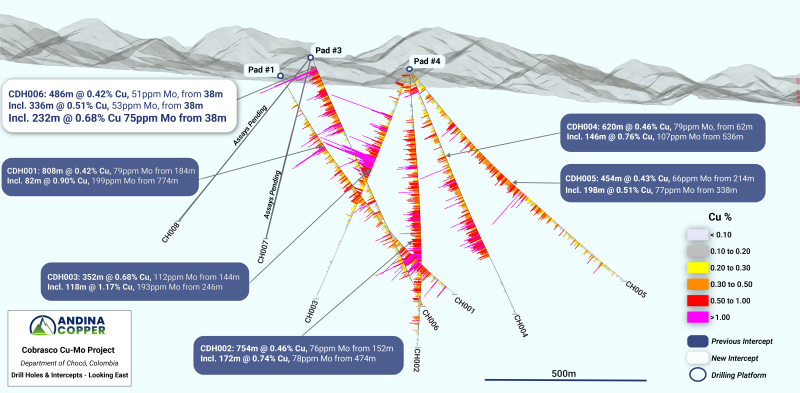
Previous drillhole CDH005 was planned as a large step-out to the south, testing the extension of the Cobrasco Central mineralized footprint towards the southern limits of the concession boundary. This drillhole was notable for wide intervals of moderate-grade mineralization in a new intermediate porphyry unit of daci-andesitic composition (refer Table 1: Cobrasco Project - Significant Drill Intercepts). The discovery of large intercepts of Cu-Mo mineralization in this distinct magnetic host unit has opened broad areas for ongoing surface and down-hole exploration in the southern portions of the Cobrasco concession (refer to Figure 1).
Drillhole CDH006 was collared approximately 400m NW of the previous drill pad #4 (CDH002 – CDH005) and approximately 300m SW of pad #1 (CDH001). This new location (pad #3) will be used to drill a fan of holes testing the overall NW-extension of the mineralization footprint.
Hole CDH006 (Az: 225o Dip: -60º Depth: 898.90m), being the first hole from this drill pad was collared to test a SW section, parallel to holes CDH001 and CDH004, covering approximately 500m in the horizontal and 750m in the vertical planes. In broad terms, the lithologies intersected in CDH006 correspond to felsic porphyries of rhyodacite composition with mineralized intervals related to chalcopyrite sometimes replaced by bornite in intensely fractured rocks.
Hydrothermal alteration is strong argillic in the upper portions of the drillhole, progressing to phyllic and ubiquitous grey-green-sericite (GGS) which has been associated with the bulk of the mineralization defined thus far.
Click here to see Figure 2: Oblique 3D view of drillholes at the Cobrasco Project (view looking NE)
The importance of structural controls to the observed mineralization is more evident in drillhole CDH006 than in the previous holes. Here we can see a clear association between the structural preparation of the host units (shearing and brecciation - related permeability) and the resulting degrees of alteration and mineralization.
In general terms, the upper approximately 46m of the drill core are strongly weathered and characterized by saprolites with strong oxidation and clay formation. A low-angle fault-structure (sub-parallel to drill axis) at this point marks the introduction of high copper and molybdenum grades (e.g. sample G517536: 46 - 48m 4.6% Cu, 1495ppm Mo). The rocks bounding this structure are friable, with strong argillic alteration, with mineralization being predominantly pyrite-chalcopyrite with traces of bornite. At greater depths, lithology is characterized by more competent units of rhyolite and rhyodacite with local occurrences of quartz-sulphide veining. Alteration is typically weak to moderate GGS increasing to phyllic alteration particularly over zones of brecciation. A well-marked zone of magmatic brecciation in the felsic porphyry units extends to 270m, typically characterized by an increase in A-veins and high Cu-Mo grades. The interval 38m to 270m contains the stand-out mineralized intercept reported in this announcement (232m at 0.68% Cu, 75ppm Mo from 38m).
Refer to Figure 3 which describes characteristic examples of host lithologies, alteration and mineralization in the upper 270m of drillhole CDH006.
A faulted contact at 808m marks the end of the magmatic-hydrothermal brecciation in the drillhole and the start of a distinct polymictic intrusive breccia showing matrix-supported sub-angular to sub-rounded rhyolite to microdiorite fragments in a pyritic matrix. Mineralization decreases markedly although sporadic mineralized intervals continue to the end of hole (e.g. Sample G543022: 894 – 896m 0.48% Cu, 58ppm Mo).
Refer to Figure 4 which describes a selection of characteristic samples from the deeper (> 270m) sections of drillhole CDH006.
The Company’s Corporate Presentation is available at: Andina Copper Corporate Presentation
Interested parties can subscribe to our mailing list and follow our social media channels in the links below:
Mailing List | Andina Copper LinkedIn | Andina Copper X | Andina Copper Instagram
ON BEHALF OF THE BOARD
Joseph van den Elsen
President & Chief Executive Officer
[email protected]
Jordan Webster
VP – Technical Communications
[email protected]
QUALIFIED PERSON
Francisco Montes, a consultant of Andina Copper Corp and a “qualified person” (“QP”) within the definition of that term in National Instrument 43-101, Standards of Disclosure for Mineral Projects, has reviewed and approved the technical information contained in this news release. Francisco Montes is a member of Australian Institute of Geoscientists (MAIG #4160).
QAQC
CDH006 was collared with a PQ size drill string to a depth of 138m, continued with HQ/HQ3 to 678.10m and completed to a final depth of 898.90m with NQ/NQ3 diameter rods. In all cases the drill core was extracted from the core barrel by the drill contractor under the supervision of Andina Copper personnel and placed in core boxes with appropriate depth markers (core blocks) and padding added for extra protection during transport. Full core boxes were then sealed before being transported by helicopter and pickup truck to the Cobrasco core cutting facility in Quibdó. Core was cleaned where required, marked-up and photographed, prior to undergoing geotechnical and geological logging. All core was cut by diamond saw by Andina Copper technicians, other than the top saprolite intervals that could be cut and sampled by hand tools. All sampling was conducted in nominal 2m intervals with cut-lines marked by the supervising geologists to ensure representative sampling. Samples were placed in plastic bags with non-repeatable sample tags and bagged in polyweave sacks ready for transport.
The core trays with the remaining half-core are stored at the Andina Copper facility in Quibdó for ongoing geotechnical (Terraspec spectral analysis, magnetic susceptibility readings, rock density measurements) and follow-up detailed geological logging. From Quibdó, core samples were sent to the ALS preparation facility in Medellin, an accredited laboratory which is independent of the Company. Prepared sample pulps were then sent to the ALS laboratory in Lima, Peru for gold (Au-AA23), multi-elements (ME-MS61), and “overlimits” analysis (ME-OG62 including copper Cu-OG62). Coarse and fine rejects are returned by ALS Medellin for storage at the Andina Copper storage facility.
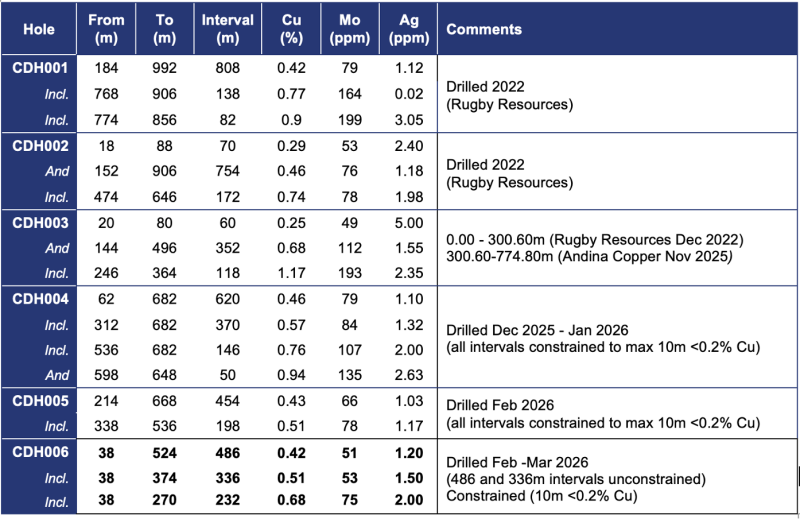
Click to see Table 1: Cobrasco Project – Significant Drill Intercepts
Note 1: The 232m @ 0.68% Cu and 75ppm Mo intercept reported for CDH006 has applied a 0.2% Cu cut-off and maximum dilution of 10m throughout the reported intercept. The other intervals shown in Table 1 for CDH006 are unconstrained but demonstrate the continuity of down-hole mineralization.
Note 2: Interval widths are measured down-hole and uncorrected. They do not necessarily represent true widths of mineralization.
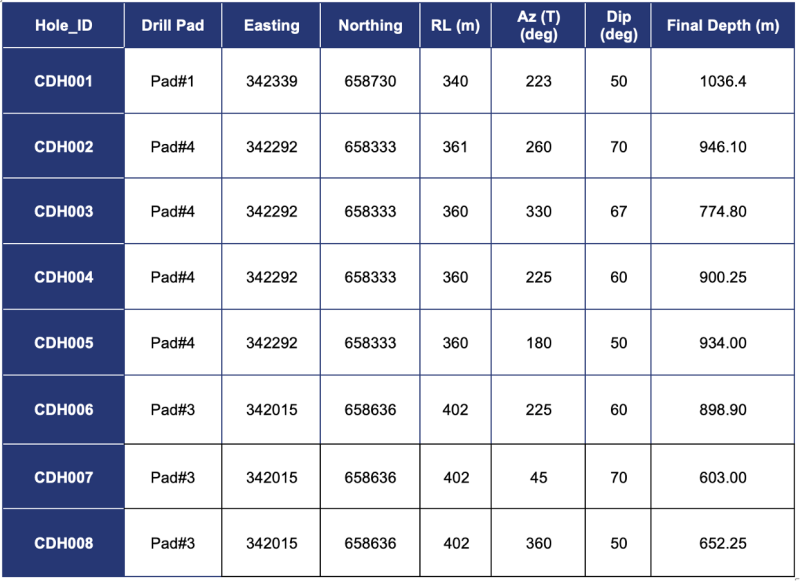
Click to see Table 2: Cobrasco Project – Drill Collar Parameters (WGS84, UTM Zone 18N)
ABOUT ANDINA COPPER
Andina Copper Corporation is a unique South America- focused copper explorer listed on the TSX Venture Exchange (TSXV: ANDC), Frankfurt (FSE: FIR), and OTC (OTCQB: PMMCF) exchanges. The Company holds two significant discoveries along the world’s premier copper producing Andean porphyry belt in Argentina and Colombia, and a compelling undrilled copper-gold target in the prolific copper production district of the Coastal Cordillera of Chile.
FORWARD-LOOKING STATEMENT
This news release contains certain statements that may be deemed "forward-looking statements". All statements in this release, other than statements of historical fact, that address events or developments that Andina Copper expects to occur, are forward-looking statements. Forward-looking statements are statements that are not historical facts and are generally, but not always, identified by the words "expects" and similar expressions, or that events or conditions "will" or "may" occur. These statements are subject to various risks. Although Andina Copper believes the expectations expressed in such forward-looking statements are based on reasonable assumptions, such statements are no guarantee of future performance, and actual results may differ materially from those in forward-looking statements.
Neither the TSXV nor the Canadian Investment Regulatory Organization accepts responsibility for the adequacy or accuracy of this release.
View the original release on www.newmediawire.com

This contant was orignally distributed by NewMediaWire. Blockchain Registration, Verification & Enhancement provided by NewsRamp™. The source URL for this press release is Andina Copper Reports High-Grade Porphyry Mineralization.